
I-11 Rating: Meeting your Arc Enemy
Description
This is the capstone event of the I-Ratings, congratulations on reaching this point!
Fly from Corona (AJO) to Camp Pendleton MCAS (NFG) using the Obstacle Departure Procedure and published TEC route. Shoot the VOR/DME RWY 21 approach to minimums, treating NFG as a non-towered airport (tower closed), go missed and then once established on the missed, cancel IFR and return under VFR for a full stop landing at nearby Palomar (CRQ)
Learning objectives
- understand the existence and application of Obstacle Departure Procedures (ODP), including when holding is required based on direction of flight
- understand the effectiveness of early coordination with ATC to efficiently join an approach
- understand how to fly a DME arc
- understand the option of canceling an IFR flight whilst still in the air and proceeding VFR to a different destination
Flying the Rating
To successfully complete this rating you must accomplish the following tasks:
- Fly IFR from KAJO to KNFG with the appropriate TEC route
- Inform ATC on initial contact at KAJO that you are performing the I-11 Rating
- Obtain IFR clearance and release while on the ground at KAJO
- Inform ATC either while on the ground or upon initial contact in the air of the intention to fly the ODP
- Prior to ROBNN, coordinate with ATC to conduct the KNFG VOR/DME RWY 21 approach from RABRE, including normal CTAF calls at NFG (tower closed)
- Execute the missed approach at NFG without touching down, then canceling IFR during the missed between OCN and WIPAM
- Proceed VFR to KCRQ (advisories optional) and land.
- Meet the I Ratings Practical Test Standards
Note: this rating does not include an ATC transcript.
Rating Description
Depart from Corona (KAJO) to Camp Pendleton MCAS (KNFG), filing the appropriate TEC route. Similar to the I-4 rating, the FAA’s NFDC route database is a convenient tool to find the TEC route. Note: do NOT file the departure or destination airport as part of the route.
On departure, fly the published Obstacle Departure Procedure (ODP), see the dedicated reference section below for more details. Pilots should inform ATC of their intention to fly the ODP, either in the remarks of the flight plan, or verbally after receiving the clearance, or upon initial contact with ATC once airborne. Pilots need to analyze their cleared route against the text of the ODP to determine if holding is required, and if so, up to what altitude.
Approaching NFG, pilots will coordinate with ATC to fly the VOR/DME RWY 21 approach, starting from RABRE. If their existing routing ends at OCN, it’s expected that they will coordinate amended route without reaching OCN.
NFG is a military-only field and is considered non-towered on PilotEdge. Pilots will make standard calls on the CTAF when given a frequency change to advisory at the Final Approach Fix. Pilots will go missed and then contact Socal Approach on the previous frequency, or as assigned by the controller prior to the CTAF handoff.
During the missed approach, having passed OCN and enroute to WIPAM, pilots will cancel IFR and divert to nearby Palomar (KCRQ) for a a full stop landing.
Pilots who are not yet familiar with the procedures are encouraged to research the topic through other references, especially the topic of flying DME arcs and ODPs, see the Related Materials below.
The required/recommended material list has been left empty, as it’s expected that pilots are able to retrieve Airport Facility Diagrams and instrument approach plates at this stage of the program. The ODP is available in the Special Takeoff Minimums publication, available through the KAJO airport page on Skyvector and other online sources.
The ODP is included inline here as a discussion point, but pilots should be become equally comfortable retrieving them through public sources as they should be consulted as part of standard IFR flight planning in cases where ATC does not provide a radar vector or SID.
Obstacle Departure Procedures
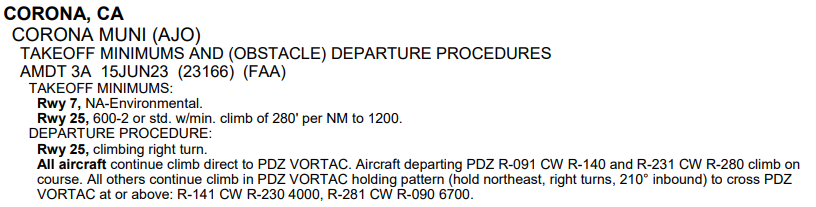
ODP’s provide obstacle and terrain separation for departures out of a specific airport. They exist in cases where an airport has been surveyed for obstacles (ie, it has one or more instrument approaches) and has been found to have obstacles or terrain that would be a factor if an airplane were to depart in a random direction at a minimally acceptable climb gradient. See the workshop in the Related Materials for more details as to when ODPs are developed for an airport.
ODPs may be flown any time ATC has not assigned a Standard Instrument Departure (SID) or a radar vector, even when they are not included in the clearance. In some rare cases, they may also be assigned by ATC for separation and traffic flows.
Reviewing the ODP, it can be summarized as follows: Turn towards PDZ VORTAC (right turn from rwy 25). If you’ll be eventually be departing PDZ on a course of 091-140, or 231-280, you can continue on course after PDZ. Otherwise, HOLD NE at PDZ on the 030 radial, right turns) to cross PDZ at or above 4000 (courses 141-230) or 6700 (281-090) before proceeding on course. Astute readers might notice that the PDZ R-030 is actually V8.
Suffice to say, it’s important to check your routing to see which course will be flown after PDZ as it determines whether holding is required, and up to which altitude.
Thank you for participating in the I-Ratings! If you’re looking for more Ratings, you’re free to take part in the Sky High Charters program!
Related Materials
PilotEdge Workshop: IFR Departures Demystified
Workshop covering IFR departures, including Obstacle Departure Procedures
PilotEdge Workshop: DME Arcs from the Cockpit
Workshop covering DME arcs flown for practice under VFR, and then again as part of an IFR approach


